Inner Child Healing, Self-Abandonment, and Reclaiming Your Worth
There’s a moment many of us don’t realize is pivotal. It’s the moment you judge yourself, and then choose not to feel the pain beneath that judgment. That moment is where self-abandonment begins. Not loudly. Not dramatically. Quietly. And when we abandon ourselves, we don’t stop needing love. We just start looking for it in places that can’t sustain us.
The Inner Child You Learned to Ignore
Inside you lives your inner child, the emotional, intuitive, feeling part of you that learned very early what was safe to express and what wasn’t.
This part of you needs: Love Approval Safety Emotional presence
When those needs weren’t met consistently, by caregivers, partners, or even by life itself…you may have learned to silence them.
You judged your feelings. You minimized your pain. You told yourself to “get over it.” But your inner child didn’t disappear. They waited. How Self-Judgment Creates Emotional Hunger When you ignore your own pain, your inner child goes looking for relief elsewhere. That’s when emotional hunger shows up as: People-pleasing Over-giving Fear of rejection Anxiety in relationships Hyper-focus on others’ moods Needing reassurance to feel okay This isn’t manipulation in the way people often shame it. It’s survival. A wounded inner child will do whatever it takes to feel loved, even if that means shrinking, controlling, blaming, or becoming overly compliant.
The Addiction No One Talks About: Approval
When you don’t give yourself love, approval becomes currency.
You start chasing: Validation Attention Being chosen Being needed
Your worth becomes something other people grant, or withhold.
Without realizing it, you’ve handed your inner child over to others for adoption, hoping someone will finally give them the love you were never taught to give yourself.
This is where relationships begin to feel unsafe, exhausting, or imbalanced. Because no one can fill the role you abandoned.
Why This Pattern Pushes Love Away Here’s the painful truth to:
The more desperately you need love, the harder it becomes for others to stay close.
Neediness can show up as: Clinginess Emotional volatility Controlling behaviors Over-functioning Self-betrayal
And when relationships strain under that weight, it reinforces the original wound: the emotional and mental state of mind that tells you that you are alone.
But the truth is simpler, and kinder. You weren’t too much. You were emotionally unmet.
Her Legacy Unchained: Choosing Self-Devotion Over Self-Abandonment
At Her Legacy Unchained, healing begins with one radical shift:
You stop outsourcing your worth.
Inner child healing looks like: * Listening to your feelings without judgment. * Offering compassion instead of criticism. * Sitting with discomfort instead of numbing it. * Reparenting yourself with consistency and care.
When you choose yourself, the inner child inside you finally feels safe.
They stop begging. They stop performing.
They stop panicking.
Love becomes something you share, not something you chase.
Breaking the Cycle for the Next Generation
When you heal self-abandonment, you don’t just change your relationships, you change your legacy. You teach your nervous system that love doesn’t have to be earned. You model emotional safety, for yourself and for those watching you. You stop passing down unmet needs disguised as strength.
And that is how cycles end. Not through perfection. But through presence.
If you enjoyed reading this, please follow me and share it with someone who may need to hear these words.
There is a particular kind of complexity that comes with loving a parent who was not safe, and then finding yourself showing up for them when they are most vulnerable.
My mother is critically ill and in the ICU. And despite everything my body remembers, the fear, the instability, the harm, I am here. I am present. I am worried. I am grieving in ways that don’t have clean edges.
This is not a story about forgiveness being easy. This is a story about holding truth without abandoning myself.
Growing Up With Instability
My mother was mentally unstable for much of my childhood. I didn’t have those words then; I only knew what it felt like to live around unpredictability.
She would often tell me that I made her nerves bad. That my presence overwhelmed her. That I was too much.
As a child, I internalized that message. I learned early that my needs were dangerous, that my emotions caused harm, that love was fragile and conditional. I learned to shrink myself in order to survive.
That is how generational trauma often begins, not with cruelty alone, but with untreated pain passed down through silence and volatility.
She Was Not Stable — and I Paid for It
My mother was mentally unstable for much of my life.
That’s not an insult. It’s a fact that I didn’t have language as a child.
She used to tell me that I made her nerves bad. That I stressed her out. That something about me overwhelmed her.
When you hear that enough as a child, you don’t question it — you absorb it. I learned that my existence was a problem. That love came with conditions. That if she was upset, it must be my fault.
That belief followed me into adulthood. Into relationships. Into motherhood.
The Night That Never Leaves Me
About a month after I had my first daughter, when my body was still healing, when my hormones were raw, when I was already emotionally exposed, she beat me.
Not yelled. Not argued. She beat me badly.
There was no clear trigger. No moment I can point to and say that’s when it went wrong. One second, things were normal, and the next, she was hitting me. I remember freezing. I remember confusion more than pain. I remember thinking: Why is she doing this? What did I do?
I replay that moment over and over, even years later, trying to understand why it happened. Trying to find one detail that is clear enough to where it makes sense. Trying to make it hurt less by understanding it.
Despite it all, it never made sense, and it can never be explained.
Being attacked by your mother after becoming a mother yourself leaves a mark that never fully fades. It’s a pain that sinks in deep, hitting you emotionally, physically, mentally, and spiritually. And sooner or later, it cracks something wide open.
It cracks open all those old wounds I thought I’d packed away, the ones from my childhood where love always came mixed with criticism, silence, or sudden anger. The moment I became a mom, everything flooded back. Holding my tiny baby, feeling that overwhelming urge to protect her, I finally got how wrong it felt to be hurt by the one person who was supposed to keep me safe. Why did her words sting so much more now? Why did a sharp tone from her send me into full panic while I whispered soft comforts to my little one?
This is the mother wound doing its work, that quiet intergenerational trauma passed down like a family heirloom nobody asked for. It’s not just my story; it’s ours. So many of us carry pieces of our mothers’ unresolved pain, handed down from grandmothers who survived hardship, loss, abuse, or a world that told women to shrink and stay quiet. My mom’s outbursts, the cutting words, the emotional storms that sometimes turned physical, they didn’t come from nowhere. She grew up with a mother battling mental illness, in a time when support for women was scarce. Knowing that helps me understand, but it doesn’t erase what happened.
Still, in that cracking open, something unexpected showed up: a clear view of the pattern. Motherhood lit it all up. The constant alertness I felt around my baby echoed my own childhood fears. The voice in my head saying I wasn’t good enough sounded just like hers. I saw how easily I could hand this down, losing patience in tired moments, pulling away emotionally, or letting old anger spill over.
But I decided not to. Healing began with calling it what it was: generational trauma, the mother wound, mental illness running through our family line. Therapy became my safe place, where I could grieve the mom I wished I’d had, let myself be angry about what wasn’t fair, and start forgiving without pretending it was okay.
I learned to mother myself too: talking kindly to my reflection, drawing firm boundaries with her (even if that meant stepping back), and putting my own mental health first without guilt.
Loving the parent who hurt me doesn’t mean forgetting or forcing a picture-perfect relationship. It means making room for compassion while guarding my own peace.
Some days it’s still emotionally raw. Triggers sneak up when I least expect them. But the pain doesn’t own me anymore. It’s turned into something with meaning.
By healing, I’m not just getting by, I’m stopping the hand-off.
The Collision of Trauma and Illness
Now, years later, I find myself worried about her comfort. Her fear. Her pain. And I am holding a painful contradiction: the person who hurt me is now someone I am afraid of losing.
That does not erase what happened. Her illness does not undo the damage. My presence now does not rewrite the past.
And yet, here I am, navigating grief layered with memory, love tangled with fear, compassion complicated by history.
This is the reality of generational trauma: you can understand where someone’s pain came from and still carry the scars of what they did with it.
Being Present Without Self-Betrayal
Being present for my mother now does not mean I excuse the abuse. It does not mean I deny my fear. It does not mean I forget the harm.
It means I am choosing conscious presence instead of unconscious repetition.
I am allowed to hold boundaries. I am allowed to feel anger and compassion at the same time. I am allowed to love without sacrificing my safety, emotionally or otherwise.
This is not martyrdom. This is awareness.
Breaking generational cycles does not always look like walking away forever. Sometimes it looks like staying with clarity, refusing to gaslight yourself, and refusing to pass the pain forward.
For Anyone Who Is Here Too
If you are caring for a parent who was mentally unstable… If you are showing up for someone who once made you feel unsafe… If you are loving someone whose actions left marks that time didn’t erase…
Please hear this:
You do not owe silence. You do not owe forgiveness. You do not owe access to your inner child.
You owe yourself the truth. You owe yourself safety. You owe yourself compassion.
Choosing to be present does not mean you are weak. It means you are aware, and awareness is how cycles end.
Holding Both
I don’t know how this will end. I don’t know what healing will look like after this. I don’t know what I will feel tomorrow.
But I do know this: I am no longer the child who thought she caused her mother’s instability. I am no longer responsible for someone else’s untreated pain. And I am allowed to hold love without losing myself.
I thought something was wrong with me for most of my life. It seemed like I didn’t fit in anywhere I went.
I didn’t know that the burden I bore had a name: generational trauma.
I used to think that what I regarded as weakness was what made me strong enough to end the pattern.
The Quiet That Said More Than Words
The hardest thing for my family to carry was silence.
Addiction. Trauma. Quiet sadness. They were all there long before I arrived.
I saw countless family members I loved dearly simply get through life, but not really experience it. Plans for the future were put on hold. As time went on, their hearts began to turn cold.
Don’t get me wrong, there was some display of affection. But in my most of the time, that was something you had to earn in my household.
When I asked questions like:
“Why do we keep acting like this?”
“Why doesn’t anyone in this family ever say they’re sorry?”
A lot of my relatives sighed and some even looked at me sideways.
But I knew deep down that this wasn’t how the story was supposed to end, at least not my story. From a young age, I knew I would ultimately be the one who would break the pattern and save the future.
Becoming the Pattern Breaker
When you’re in it, it doesn’t necessarily feel good to interrupt the cycle. It leaves you with this overwhelming feeling of being alone, and misunderstood.
Often times, it can look like you’re crying in your car after you set limits that your younger self would have begged for. It means putting healing ahead of hiding, God ahead of guilt, and treatment ahead of tradition.
What Healing Looked Like for Me
No more letting people I love control my feelings.
I wish I had different parents, but I forgive the ones I do have.
Loving myself without needing anyone else’s approval.
I hugged myself and whispered, “You are safe now.”
I used to ask God to make me normal, but he didn’t. To help me stop feeling so much. To help me feel like I belong.
But my prayer altered over time.
I thank Him now.
I finally get it: I wasn’t born into this family to fit in. I was born to be free.
Healing isn’t only for me.
It’s for my kids.
It’s for their kids.
And it’s for the little girl I used to be, the one who needed someone like me.
The Black Sheep Could Be the Shepherd
If people have labeled you the black sheep of your family, here’s the truth: You might really be the shepherd!
It’s hard to be the one who says, “No more.” But every time you say those words, you’re making something new.
Your family might not know how much they need you, but they do. And certainly, it can be lonely at times.
But legacy never really begins in a safe place. It all starts with one brave person doing what everyone else is too scared to do.
You Are Not Alone
If you think you don’t fit in because you’re too sensitive, too spiritual, too honest, or too different, please listen to me:
You are not too much. You’re simply right.
You were born to break the cycle. Now, go create something lovely.
If this spoke to you, share it with someone who needs the reminder that their peace is worth protecting.
For a long time, I believed that spiritual knowledge was being kept from me. As if someone, somewhere, held all the answers, and I simply hadn’t been granted access yet.
But healing has a way of gently correcting our assumptions.
What I’ve come to understand is this:
Nothing was ever hidden!
The truth was always near me, within reach, waiting for the moment I was ready to truly see it.
Wisdom Doesn’t Shout, It Whispers
The most sacred truths rarely come through loud declarations, formal classrooms, or rigid teachings. They arrive quietly.
In stillness. In reflection. In moments that seem ordinary until they change you forever.
I’ve felt it while sitting in silence. While watching the sun rise and realizing that the light itself was teaching me something my soul had been craving.
These moments don’t announce themselves as “lessons.” They simply are.
And if you’re paying attention, they meet you exactly where you are.
Readiness Is the Key
It’s not that anyone refuses to share the truth.
It’s that truth has a timing of its own.
Some wisdom will not reveal itself until your spirit has healed enough to hold it. Until your nervous system feels safe enough to receive it. Until your heart is open enough to listen.
This is especially true when you’re doing generational healing work.
When you’re breaking cycles.
When you’re choosing to unlearn survival patterns passed down through pain.
When you’re creating a new legacy instead of repeating an old one.
Closing Reflection: Remembering What Your Soul Already Knows
Some spiritual truths appear hidden, not to exclude anyone, but to honor the sacred nature of timing and readiness.
True wisdom isn’t learned through words alone. It’s experienced.
The ancient philosopher Plato believed that knowledge isn’t something we acquire—it’s something we remember. That our souls already carry truth, waiting for the right moment to awaken it.
And when that moment comes, it won’t arrive loudly.
It will rise quietly from within you, like a flower blooming only when the season is right.
That’s why the real work isn’t chasing answers outside yourself.
It’s turning inward. Listening deeply. Reflecting honestly. Reconnecting with the part of you that already knows.
When you do, you’ll begin to feel the universe gently guiding you, through signs, whispers, and moments of clarity that feel like coming home.
Allow the truth to unfold in its own time.
Your legacy is unchaining itself, one quiet awakening at a time.
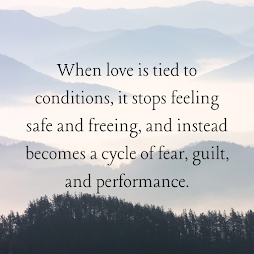
Love is supposed to feel safe, nourishing, and freeing. Yet for many of us, it feels more like duty, performance, or obedience. If you grew up in an environment where love was conditional, based on how well you behaved, obeyed rules, or met someone else’s needs, you may struggle to experience genuine love as an adult. Instead of being rooted in trust and authenticity, love becomes tangled with fear of rejection, guilt, and people-pleasing.
This struggle doesn’t mean you’re broken. It means you’ve been conditioned. And the good news? What was conditioned can be unlearned. Healing is about recognizing these patterns and slowly creating a new way of relating to yourself and others.
Childhood Conditioning and the Obedience, Love Link
Children naturally crave love and safety. In healthy families, love is given freely, without requiring the child to “earn” it. But in families marked by dysfunction, trauma, or strict control, love can feel transactional:
Be quiet, and you’ll be praised.
Follow the rules, and you won’t be punished.
Do what I say, and I’ll give you affection.
Over time, a child learns that love isn’t unconditional, it’s a reward for compliance. Instead of developing a stable sense of self, the child develops hyper-awareness of others’ moods and needs.
This is survival. But it also wires the brain and nervous system to equate love with obedience.
As an adult, you may find yourself repeating these patterns without realizing it. Maybe you:
Apologize too quickly, even when you’ve done nothing wrong.
Feel guilty when you say no.
Choose partners, friends, or jobs that demand compliance over authenticity.
Feel anxious if someone is upset with you.
If any of this resonates, you’re not alone. It’s a common response to childhood conditioning, and one that can be healed.
The Hidden Cost of Obedient Love
When love feels like obedience, it keeps us trapped in cycles of fear and self-betrayal. We learn to silence our needs, dreams, and even our intuition just to keep relationships intact. This creates:
Chronic anxiety – constantly monitoring others’ moods or approval.
Resentment – because your authentic self never gets to breathe.
Low self-worth – believing you are only valuable when serving others.
Toxic relationships – gravitating toward people who replicate your childhood dynamic.
Most importantly, it robs us of the joy and freedom that love is meant to bring. Love should not feel like walking on eggshells. It should not feel like a performance. True love accepts you in your wholeness.
Breaking Free: Rewriting the Story
Healing from obedience-based love is not about blaming your parents or caregivers forever. It’s about acknowledging the reality of your experience so you can make different choices now.
1. Recognize the Pattern
Awareness is the first step. Notice when you feel anxious about disappointing someone or when you catch yourself agreeing just to avoid conflict. Ask: Am I acting from love, or from fear of losing love?
2. Redefine Love for Yourself
Spend time reflecting on what love really means to you. Write it down. Maybe love feels like safety, honesty, and mutual respect. Maybe it feels like being accepted in your most unfiltered self. Creating your own definition of love gives you a compass for relationships.
3. Practice Saying No
For people conditioned to obey, “no” can feel terrifying. Start small. Decline an invitation you don’t want. Tell someone you need time before making a decision. Each time you honor your truth, you retrain your nervous system to see that boundaries don’t destroy love—they protect it.
4. Reparent Yourself
Reparenting means giving yourself the unconditional love and nurturing you may not have received as a child. This could look like:
Speaking kindly to yourself when you make mistakes.
Allowing rest without guilt.
Celebrating small wins, even if no one else notices.
By consistently meeting your own needs, you prove to your inner child that love isn’t earned—it’s deserved.
5. Seek Relationships That Honor You
As you heal, you may notice that some relationships feel draining or one-sided. It’s okay to step back. Seek out connections where mutual respect, authenticity, and freedom flourish. Love should expand you, not confine you.
A Spiritual Perspective
Many spiritual traditions teach that love is not meant to be controlled, earned, or withheld. True love is unconditional, flowing from Source—the divine energy that created and sustains us. When we anchor ourselves in this higher love, we begin to see that our worth has never depended on obedience.
You were born worthy. You were born loved. By reconnecting with that truth, you can free yourself from generational patterns of control and fear.
Moving Toward Freedom
Breaking free from childhood conditioning is not an overnight process. It’s a journey of unlearning, grieving, and rebuilding. There may be setbacks, but every time you choose authenticity over compliance, you reclaim a piece of yourself.
Remember:
Love is not something you earn by obeying.
Love is not fear disguised as loyalty.
Love is freedom, acceptance, and truth.
When you finally embrace this, relationships begin to feel lighter. You stop performing and start living. You stop begging for scraps of approval and start expecting respect. You stop confusing obedience with love and begin experiencing what love was always meant to be.
Final Thoughts
If love feels like obedience, it’s not love—it’s conditioning. And while you didn’t choose the patterns that shaped you, you can choose to heal them. Start by noticing, then gently challenging, the ways obedience shows up in your relationships. Over time, you’ll begin to embody a new truth:
Love does not shrink you. Love expands you. Love does not silence you. Love celebrates your voice. Love does not demand obedience. Love honors your freedom.
Your healing matters—not just for you, but for the generations after you. By breaking the chains of conditional love, you create a new legacy where love is safe, abundant, and free.